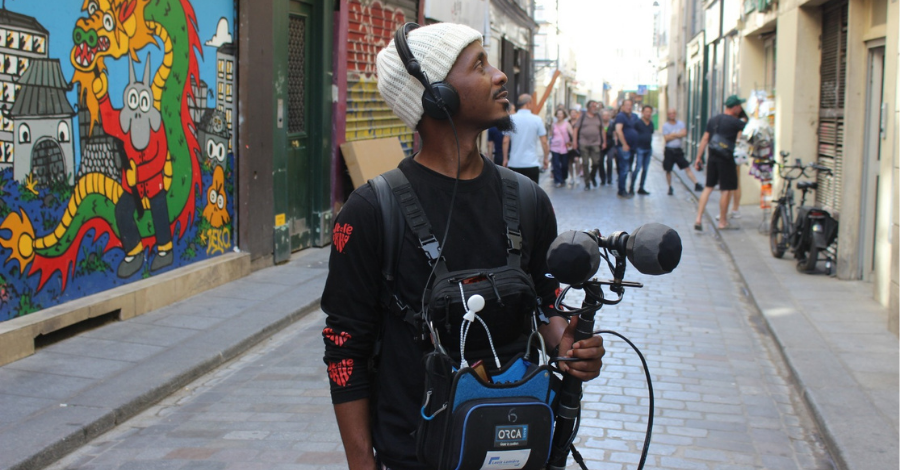
Malawian podcast producer and sound storyteller Dennis Imaan recently completed the seven-week Sound Documentary International Intensive Summer Programme at the École nationale supérieure Louis-Lumière in France.
During the residency, Dennis developed new approaches to recording, editing and sound composition while working alongside audio professionals from 11 countries. He also co-directed First Push, a documentary about Paris’s skateboarding community.
Following an earlier conversation ahead of his departure, Dennis reflects on the experience and explains how he plans to share what he learnt in Malawi.
Looking back at your residency, which experience or lesson had the greatest influence on you?
The residency changed my understanding of what a sound documentary can be. Having produced podcasts in Malawi, I arrived with an established approach to telling stories through sound. The programme encouraged me to reconsider many of those assumptions.
The soundscape sessions had the greatest influence on me. We were taught to treat sound as part of the narrative itself, rather than simply as something that accompanies it. Exercises exploring silence, the texture of a room and the weight of a pause changed the way I approach recording. I learnt that a documentary is built layer by layer.
A visit to the Musée du Quai Branly was also important. Its Resonant Museum project and sound art residency renewed my interest in archiving through sound and images. It showed how cultural memory can be preserved in forms that remain accessible and connected to people’s lives.
What documentary did you produce, and what guided your choice of subject and approach?
I co-directed First Push with Russian participant Bulat Baimatov. The documentary explores Paris’s skateboarding community through conversations with beginners, experienced riders, older skaters balancing family and work, and a skatepark designer who has developed spaces in Jamaica, Senegal and Uganda.
Recorded in and around skateparks, these conversations bring out stories of fear, injury, friendship, ageing, work, family and belonging. They also show how people from different countries, cultures and generations communicate through movement, mutual support and shared experience, even when they do not speak the same language.
My interest in the subject began with the skatepark as a shared public space. Strangers who might never speak to one another elsewhere find common ground there. This connected closely with my work on the #ReImagineLilongwe campaign and my interest in how people participate in shaping urban spaces.
The project initially focused more on institutional perspectives, including an interview with Kevin Havet, Deputy Mayor responsible for major projects in Paris’s 18th arrondissement. However, I became increasingly interested in how skaters experience and use the city in practice.
The skatepark also offered a rich recording environment. The rhythm of wheels on concrete, conversations in several languages and the response of a crowd to a successful trick all contribute to the story.
We primarily used an ORTF stereo configuration to create a natural sense of space while allowing conversations to remain spontaneous. Wide AB stereo recording helped us capture the scale and changing atmosphere of larger parks. Instead of separating interviews from ambient sound, we allowed voices, movement and the surrounding environment to interact throughout the documentary.
At its centre, First Push asks a simple question: what makes people feel that they belong? The skateboard becomes a means of movement, communication and community. Learning to skate while making the documentary was an added benefit.
Which new skills or techniques will most affect the way you record and tell stories?
Stereophonic field recording will make a considerable difference to my work. Before the residency, I was most comfortable recording in mono. I now have a stronger understanding of how stereo recording can convey space, texture, distance and movement.
The masterclasses with Charlotte Rouault and Amandine Casadamont also changed the way I think about editing. Editing is not simply about removing material. It is about finding the structure of a story within everything that has been recorded.
I also developed a greater appreciation for restraint. Some of the most effective moments in a documentary are quiet ones. I now consider what can be left unsaid and where listeners need room to form their own understanding.
Amandine’s session on creative recording set-ups was particularly useful. It showed how the recording process can create intimacy, help participants feel comfortable and encourage the producer to listen more attentively.
How did working with audio professionals from France and other countries shape your understanding of sound documentary?
Working with professionals from 11 countries introduced me to different storytelling traditions, sound environments and approaches to silence.
In France, I encountered a strong emphasis on sound documentary as an artistic form. There was close attention to craft, experimentation and the listener’s role in interpreting a story. I learnt that a documentary can invite listeners into a particular setting while allowing them to reach their own conclusions.
The feedback sessions with other participants were equally valuable. We discussed one another’s work honestly and constructively, and I learnt as much from listening to their recordings as I did from producing my own.
How do you plan to apply and share what you learnt in Malawi?
Through Kuwala Creatives and Influencer Malawi, I plan to organise workshops for young Malawian storytellers covering field recording, editing, interviewing and narrative structure.
Discussions are also under way with community radio stations, through Emmanuel Kamwenje, about developing a training module in sound documentary production. The aim is to help local communities record and present their own stories.
Meetings with Making Waves and Sacha Martinel introduced me to the Radiobox, a portable, solar-powered radio studio. I am considering how a similar model could be used in Malawi to reach communities whose perspectives are seldom included in mainstream media.
The Musée du Quai Branly visit also renewed my interest in establishing a digital audio archive of Malawian oral histories and cultural practices. Such an archive could preserve these recordings while making them accessible to future generations.
Finally, the relationships formed during the programme have created possibilities for co-productions, exchanges and documentaries involving participants from several countries.
The residency gave me stronger technical skills, greater confidence in my work and an international network of colleagues. Above all, it taught me to listen with more patience, curiosity and respect. I return to Malawi committed to applying these lessons and helping other storytellers develop their practice.
Problem displaying Facebook posts.
Click to show error